Showing posts with label history's mysteries. Show all posts
Showing posts with label history's mysteries. Show all posts
Monday, March 19, 2012
Amazing fact about the Weimar Republic
Two Jewish women (that I know of) were elected to the German parliament under the Weimar Republic: Toni Sender and Adele Schreiber-Krieger.

Thursday, March 15, 2012
People
The gay Nazi, people. It doesn't get much more sensational in an academic book.
I am just saying. It doesn't get much more like a major summer blockbuster. Why don't you want to publish it?
I mean, there was the time that a giant squid attacked the Puritans who were sailing around the Atlantic fomenting revolution with their pamphlets. But that was a one-time thing.
The gay Nazi changed gay history. The Puritan-attacking squid did not change squid history.

I am just saying. It doesn't get much more like a major summer blockbuster. Why don't you want to publish it?
I mean, there was the time that a giant squid attacked the Puritans who were sailing around the Atlantic fomenting revolution with their pamphlets. But that was a one-time thing.
The gay Nazi changed gay history. The Puritan-attacking squid did not change squid history.

Thursday, July 21, 2011
Cretinism
In the mid nineteenth century, so I read yesterday, European psychiatrists rushed to cure the dread condition "cretinism" and its attendant intellectual disability, stunted growth, and remarkable facial abnormalities.
But what caused it? Some were like: "hereditary degeneration." Other guys said: living in swampy areas, or soil conditions. They found it spreading in remote villages in the Swiss Alps, with some hamlets entirely populated by "cretins."
 (Appenzell--likely former home of many Swiss cretins.)
So, perhaps like you, I am trained to think about culture and imagination, and I am thinking: is this (yet again) elite Europeans gazing at impoverished Europeans and seeing biological degeneration rather than the actual economic and political inequalities producing poverty? But why is this happening in the Swiss Alps, not in urban slums?
So, of course, being a trained historian, I google image searched "cretinism."

OK! And people: that is not just the bourgeois imagination. Indeed, it's hyperthyroidism, caused by iodine deficiency, and it was common in Alpine villages prior to better food distribution systems because the soil in those valleys lacks iodine.
But then the imagination comes back in force, because the theory of "degeneration" so popular in nineteenth century Europe (Morel)--decadent culture, the decline of the race, the madness of the crowd, etc.--began with a study of these Swiss villagers with hyperthyroid. Degeneration won out as the explanation for what ailed them, but actually, the guys who were for the 'bad soil' explanation were correct.
Bibliography
Pick, Faces of Degeneration
Wikipedia
But what caused it? Some were like: "hereditary degeneration." Other guys said: living in swampy areas, or soil conditions. They found it spreading in remote villages in the Swiss Alps, with some hamlets entirely populated by "cretins."
 (Appenzell--likely former home of many Swiss cretins.)
So, perhaps like you, I am trained to think about culture and imagination, and I am thinking: is this (yet again) elite Europeans gazing at impoverished Europeans and seeing biological degeneration rather than the actual economic and political inequalities producing poverty? But why is this happening in the Swiss Alps, not in urban slums?
So, of course, being a trained historian, I google image searched "cretinism."

OK! And people: that is not just the bourgeois imagination. Indeed, it's hyperthyroidism, caused by iodine deficiency, and it was common in Alpine villages prior to better food distribution systems because the soil in those valleys lacks iodine.
But then the imagination comes back in force, because the theory of "degeneration" so popular in nineteenth century Europe (Morel)--decadent culture, the decline of the race, the madness of the crowd, etc.--began with a study of these Swiss villagers with hyperthyroid. Degeneration won out as the explanation for what ailed them, but actually, the guys who were for the 'bad soil' explanation were correct.
Bibliography
Pick, Faces of Degeneration
Wikipedia
Tuesday, June 8, 2010
Putting the *bad* back in tribadism
Nice, friendly reader may remember the 1000-page book, E.F.W. Eberhard's 1924 The Erotic Foundations of Women's Emancipation (Die Frauenemanzipation und Ihre Erotischen Grundlagen). I took lots of digital photographs of it in 2007 and merrily imagined myself reading it later.
Then it seemed for a long time like in fact, I would not read it later.
But yesterday I started reading chapter 6. And yes, the book is indeed the hoot that its chapter titles promised it would be.
Chapter 5: Masturbation and the Women's Emancipation Movement
Chapter 6: Tribadism and the Women's Emancipation Movement
Chapter 7: Sadism and the Women's Emancipation Movement
You couldn't publish certain descriptions of sex acts in the late nineteenth and early twentieth centuries, even if you were a scientist of sex. The sexologists got around this by putting them in Latin. E.F.W. Eberhard quotes them a lot.
The thing is, you can often tell what they mean, even if you do not speak Latin (or if your Latin teacher did not go over this vocabulary in high school):
frictio genitalium mutua (p. 538)
Which is good, because the online Latin dictionary run by Notre Dame University is no help.
Then it seemed for a long time like in fact, I would not read it later.
But yesterday I started reading chapter 6. And yes, the book is indeed the hoot that its chapter titles promised it would be.
Chapter 5: Masturbation and the Women's Emancipation Movement
Chapter 6: Tribadism and the Women's Emancipation Movement
Chapter 7: Sadism and the Women's Emancipation Movement
You couldn't publish certain descriptions of sex acts in the late nineteenth and early twentieth centuries, even if you were a scientist of sex. The sexologists got around this by putting them in Latin. E.F.W. Eberhard quotes them a lot.
The thing is, you can often tell what they mean, even if you do not speak Latin (or if your Latin teacher did not go over this vocabulary in high school):
frictio genitalium mutua (p. 538)
Which is good, because the online Latin dictionary run by Notre Dame University is no help.
Wednesday, May 26, 2010
Lesbian skeletons found by archeologists!
Wars, natural catastrophes, and indeed all situations with great danger and uncertain outcome, will quickly upset regimes of pleasure and desire.
There are countless episodes in history that prove this. A classic example is ancient Pompeii. Many skeletons found there, it’s well known to researchers, are in the act of having sex. In one house: lesbian skeletons. One has its hand on the other’s pubic region.
--Franz Scott (partial paraphrase), Das Lesbische Weib, 1933
Tuesday, November 10, 2009
Thursday, October 8, 2009
Jaw-dropping historiography experience
Yesterday this retired old guy historian (old white guy) came to visit us. He just won a big prestigious award for his book. He gave a talk about writing the book.
He said the following.
"I wanted this book to be inclusive. I wanted to include the old, traditional history, because it is still valuable. And I also wanted to include the newer types of history that many historians are working on."
Me silently thinking: Oh, OK. Well, at least you are including the new stuff.
He elaborated:
"I wanted to include traditional history--political, diplomatic, and military history..."
Me thinking: Oh, good. Now I know what those are.
Old guy: "And I wanted to include the new history--"
Me thinking, as you probably are: hmm, how will I feel when he categorizes women's history as "a newfangled kind of history that he wanted to include," will I feel OK about that? Or patronized?
Old guy: "The new kinds of history: cultural, social, and economic history."
Me: panicking.
Note: Social history was "new" in 1970.
He said the following.
"I wanted this book to be inclusive. I wanted to include the old, traditional history, because it is still valuable. And I also wanted to include the newer types of history that many historians are working on."
Me silently thinking: Oh, OK. Well, at least you are including the new stuff.
He elaborated:
"I wanted to include traditional history--political, diplomatic, and military history..."
Me thinking: Oh, good. Now I know what those are.
Old guy: "And I wanted to include the new history--"
Me thinking, as you probably are: hmm, how will I feel when he categorizes women's history as "a newfangled kind of history that he wanted to include," will I feel OK about that? Or patronized?
Old guy: "The new kinds of history: cultural, social, and economic history."
Me: panicking.
Note: Social history was "new" in 1970.
Friday, May 22, 2009
In the big time now
Hey reader, check it out--I got my picture taken in front of something that there's a picture of in Making of the West.

The MOW is the textbook that taught me everything I know about European history.
MOW is the one constant and reliable support in grad student life and is therefore beloved. When asked in job interviews how I would teach a survey class: "Well, I would assign MOW..." Some grad-student-taught summer courses are actually (semi) dramatic readings of the MOW.

The MOW is the textbook that taught me everything I know about European history.
MOW is the one constant and reliable support in grad student life and is therefore beloved. When asked in job interviews how I would teach a survey class: "Well, I would assign MOW..." Some grad-student-taught summer courses are actually (semi) dramatic readings of the MOW.
Friday, May 1, 2009
Night of the spooky bike tour
Yesterday, April 30, was a creepy evening here in Berlin. It was Walpurgisnacht, the festival of the witches's dance, and also the anniversary of Hitler's suicide.
When the sun set, I went on a bike ride to a) look for witches and b) look for neo-Nazis discretely observing the anniversary.
First stop: Hitler's bunker, the site of his and his wife Eva Hitler (formerly Braun)'s suicide and the erstwhile site of their graves.

As you can see, it's now a parking lot. (The bunker was mostly destroyed by the Soviets and later by the East German government, though the floor and walls are apparently still down there.) For years there was no sign. From what I've read, the city didn't mark the site to keep it from becoming a neo-Nazi shrine.
But according to the sign pictured above, since the movie Downfall came out, there's been so much interest that they put up said sign.
So, is it a neo-Nazi shrine? Well, there weren't any neo-Nazis lurking around. (I may have missed their real holiday, H.'s birthday.)
There was that guy with a camera and microphone just sitting by the sign (pictured). Hmmm, what was he up to? Waiting for a ride? Surreptitiously recording what was going on?
Sorry--I have no idea because I didn't ask him.
Additional Hitler/Braun trivia: Burned and then buried in the garden above the bunker, their remains did not rest there for long, but were dug up by the Soviets, identified with dental records and x-rays, and shipped to a KGB barracks near Magdeburg, Germany, where they languished until 1970, when the KGB fully cremated them and tossed the ashes in a river. The Soviets kept the story of the remains secret, and until the end of the Cold War a mystery surrounded the final whereabouts of the bodies.
Next stop: The search for witches!
Walpurgisnacht is an ancient pagan spring festival that involves witches jumping over bonfires. In Berlin, it got mixed up with May 1, which is the next day. May 1 or International Worker's Day, which is today (!!), involves left demos and rioting.
There used to be a big Walpurgisnacht party, which I guess often turned into a riot, in a park in the neighborhood in which I'm staying. I biked over there (pictured below).

It was pretty cool! I did see one little kid dressed as a witch. Lots of people where there, all drinking beer--punks, parents, people my age, older folks, little kids (they did not appear to be drinking beer). Also a bunch of bands. And fire juggling. And a bonfire.

Walpurgisnacht I guess is tamer than it once was. No rioting that I saw. But a whole army of police were in attendance, as they have been at every gathering of more than twenty people that I've ever been to in Berlin.

These police are the "Anti Conflict Team." They wore these vests. I was unsure whether the vests were working or not.
When the sun set, I went on a bike ride to a) look for witches and b) look for neo-Nazis discretely observing the anniversary.
First stop: Hitler's bunker, the site of his and his wife Eva Hitler (formerly Braun)'s suicide and the erstwhile site of their graves.

As you can see, it's now a parking lot. (The bunker was mostly destroyed by the Soviets and later by the East German government, though the floor and walls are apparently still down there.) For years there was no sign. From what I've read, the city didn't mark the site to keep it from becoming a neo-Nazi shrine.
But according to the sign pictured above, since the movie Downfall came out, there's been so much interest that they put up said sign.
So, is it a neo-Nazi shrine? Well, there weren't any neo-Nazis lurking around. (I may have missed their real holiday, H.'s birthday.)
There was that guy with a camera and microphone just sitting by the sign (pictured). Hmmm, what was he up to? Waiting for a ride? Surreptitiously recording what was going on?
Sorry--I have no idea because I didn't ask him.
Additional Hitler/Braun trivia: Burned and then buried in the garden above the bunker, their remains did not rest there for long, but were dug up by the Soviets, identified with dental records and x-rays, and shipped to a KGB barracks near Magdeburg, Germany, where they languished until 1970, when the KGB fully cremated them and tossed the ashes in a river. The Soviets kept the story of the remains secret, and until the end of the Cold War a mystery surrounded the final whereabouts of the bodies.
Next stop: The search for witches!
Walpurgisnacht is an ancient pagan spring festival that involves witches jumping over bonfires. In Berlin, it got mixed up with May 1, which is the next day. May 1 or International Worker's Day, which is today (!!), involves left demos and rioting.
There used to be a big Walpurgisnacht party, which I guess often turned into a riot, in a park in the neighborhood in which I'm staying. I biked over there (pictured below).

It was pretty cool! I did see one little kid dressed as a witch. Lots of people where there, all drinking beer--punks, parents, people my age, older folks, little kids (they did not appear to be drinking beer). Also a bunch of bands. And fire juggling. And a bonfire.

Walpurgisnacht I guess is tamer than it once was. No rioting that I saw. But a whole army of police were in attendance, as they have been at every gathering of more than twenty people that I've ever been to in Berlin.

These police are the "Anti Conflict Team." They wore these vests. I was unsure whether the vests were working or not.
Thursday, July 19, 2007
The 19th C will always welcome you back
I signed up to teach this class called AGE OF EUROPEAN EXPANSION and sadly Europe started expanding--yes, that's right, try not to panic--before the French Revolution. You know, in that gray and fuzzy time period I like to call "Back in the Day" (or BITD). When Europeans like, road on burros wacking each other with clubs and had witchcraft familiars named Snoony Tom and didn't believe in evolution. It is also called Olde Time and Ye Olde Time.
So the whole first two weeks of this class, I find myself saying things like, "As the Portuguese extended their chain of forts down the west coast of Africa," and using the word "15" things. As in, "1519" and "1562." Numbers that start with 15. As in, as my own voice comes out of my head, it triggers a faint memory of my 10th grade civics teacher saying much the same thing. And terror. It triggers terror, because instead of the old, familiar and answered-before questions (ex: "Was Hitler gay?") you get stopped in your paces whilst in front of your class with doozies like "Did the Maya have money?" "How did the Aztecs select their kings?" "What was the population of the largest city in Europe in 1500?"
Answer: "Well, the Maya didn't have money as we understand it, of course, but they did have units of exchange."
Answer: "Aztec king selection was a complicated affair, with heavy priest involvement and possible human sacrifice."
Follow-up question: "So, did the Aztecs have a hereditary monarchy?"
Answer: "Well, not per se, but being related to the former ruler helped one get power."
(Note: Post-class research revealed that the Mayan money answer is correct (thanks to roommate research dept.) but the Aztec answer is totally wrong!)
It makes you even wish once again to hear the well-known ring of, "I saw a show on the History Channel--Was Hitler on drugs?"
(Note: the show is called "High Hitler.")
Anyway, but finally tomorrow we are moving on to the Atlantic Slave Trade and the book I've assigned takes place in 1823. Whew. I never thought I'd be so glad to see the 19th C. The 19th C, when things finally start making sense.
I feel bad that I once called it "the null century."
So the whole first two weeks of this class, I find myself saying things like, "As the Portuguese extended their chain of forts down the west coast of Africa," and using the word "15" things. As in, "1519" and "1562." Numbers that start with 15. As in, as my own voice comes out of my head, it triggers a faint memory of my 10th grade civics teacher saying much the same thing. And terror. It triggers terror, because instead of the old, familiar and answered-before questions (ex: "Was Hitler gay?") you get stopped in your paces whilst in front of your class with doozies like "Did the Maya have money?" "How did the Aztecs select their kings?" "What was the population of the largest city in Europe in 1500?"
Answer: "Well, the Maya didn't have money as we understand it, of course, but they did have units of exchange."
Answer: "Aztec king selection was a complicated affair, with heavy priest involvement and possible human sacrifice."
Follow-up question: "So, did the Aztecs have a hereditary monarchy?"
Answer: "Well, not per se, but being related to the former ruler helped one get power."
(Note: Post-class research revealed that the Mayan money answer is correct (thanks to roommate research dept.) but the Aztec answer is totally wrong!)
It makes you even wish once again to hear the well-known ring of, "I saw a show on the History Channel--Was Hitler on drugs?"
(Note: the show is called "High Hitler.")
Anyway, but finally tomorrow we are moving on to the Atlantic Slave Trade and the book I've assigned takes place in 1823. Whew. I never thought I'd be so glad to see the 19th C. The 19th C, when things finally start making sense.
I feel bad that I once called it "the null century."
Tuesday, February 20, 2007
History of the party!
I didn't want to be one of those serious, bummer grad students who teach summer classes on mass murder and all that in unairconditioned rooms. I wanted to be fun and hip. I wanted my dissertation to be, like, the history of the party.
Happy times!
Like, "In the 18th Century, parties were considered to be universal, but then in the 19th C with the rise of the new "science" partyology, parties were thought to be biologically based but, with the invention of making out and the cocktail, began to totally rock!" Etc.
You know, dancing naked nuns. Yeah?
Anyway, but now I am reading all this stuff on a bummer topic. Yes, it's sterilization. "Voluntary" sterilization. When you are talking about "voluntary" sterilization with the word 'voluntary' in quotation marks, that is no party man. People say, 'what are you up to?' and I get all agitated telling about "voluntary" sterilization. With 'voluntary' in quotation marks. Hand-signal quotation marks. Yikes.
Happy times!
Like, "In the 18th Century, parties were considered to be universal, but then in the 19th C with the rise of the new "science" partyology, parties were thought to be biologically based but, with the invention of making out and the cocktail, began to totally rock!" Etc.
You know, dancing naked nuns. Yeah?
Anyway, but now I am reading all this stuff on a bummer topic. Yes, it's sterilization. "Voluntary" sterilization. When you are talking about "voluntary" sterilization with the word 'voluntary' in quotation marks, that is no party man. People say, 'what are you up to?' and I get all agitated telling about "voluntary" sterilization. With 'voluntary' in quotation marks. Hand-signal quotation marks. Yikes.
Sunday, June 18, 2006
Remembering the Battle of Berlin
The Fan Mile runs right past the memorial (pictured--see the huge statue on the pillar?) to the Red Army's conquest of Berlin in 1945. I read somewhere that this is the only memorial to a foreign army in a European capital city.  Note the thoughtful-of-history look on this face (pictured)? Soccer and European history are not mutually exclusive after all.
 Note the thoughtful-of-history look on this face (pictured)? Soccer and European history are not mutually exclusive after all.
Saturday, June 3, 2006
Tschuss, Palast der Republik
 Berlin was divided into east and west according to what was occupied by the Red Army when the war ended in '45 and what was occupied by the Brits, U.S., and French (yes, they gave the French a zone of occupation). The Red Army fought the battle of Berlin, so they had the best parts of the city under their control. As the 1940s wore on, the split became permanante. So, the DDR got the best parts of the city--the main drag (Unter den Lindin) with the major government buildings, the cathedral, the university, the opera house, and the library. West Germany built new versions of these things.
The communists tore down a baroque 19th Century castle to build their new capital building, the Palast der Republik. (Down with the monarchy, up with socialism!) But it was the 1970s: it's got bronze curtain walls, and clashes with its 19th C surroundings. After communism fell, the Palast was deserted save for the occasional rock concert. They found asbestos in it. It sat across from the cathedral and rotted away, the ruins of East Germany. I thought it was grand.

But now, they're tearing it down. There was a big debate over whether to keep it as a historical monument (I mean, duh, obviously that's the way to go). But, guess what. The parliment voted to demolish the Palast and to reconstruct the 19th Century castle that it replaced. Talk about whitewashing German history. Below, it's the demolition work from the canal side. You can see in the first image that they've torn the whole front off it. Do you still believe in socialism?
Hallo Karl und Friedrich
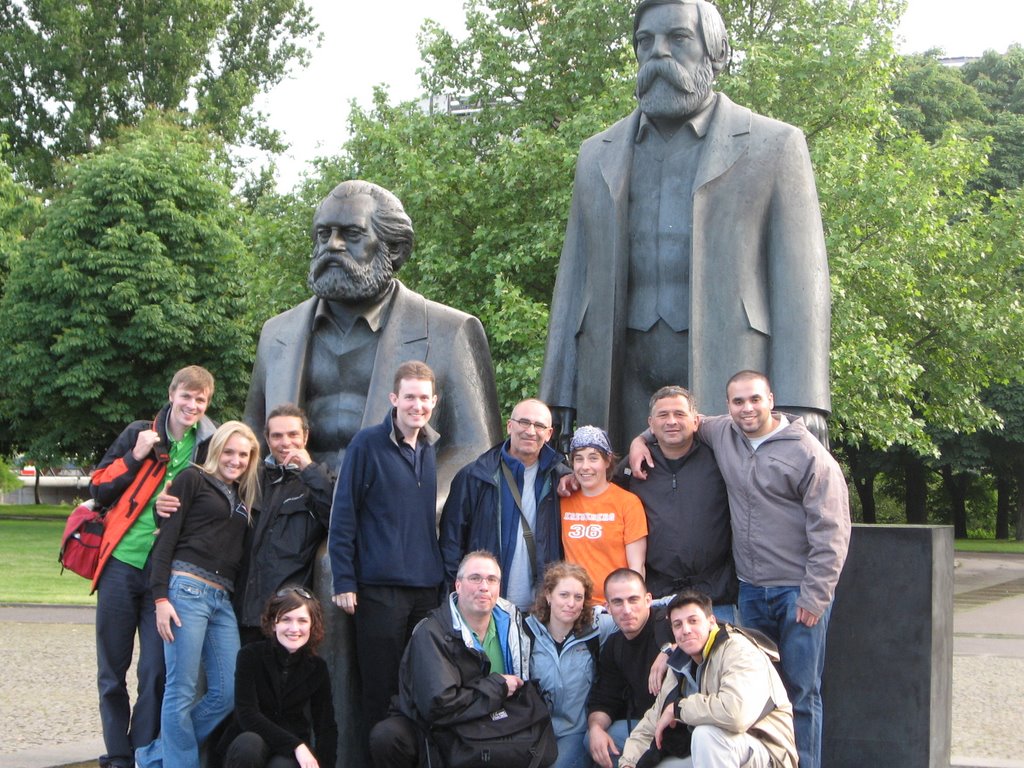
In the old downtown of East Berlin, there's a park, and in the center of the park, there are two huge statues of Marx and Engels. I've always wanted a picture of myself with the guys. I went running by the park the other day. There was a big group of tourists taking pictures with the statues. I had my camera, so I figured what the heck. I asked this guy to take my picture. Not only did he oblige, he had his entire tour group jump in the picture with me. So here is me, a bunch of Israelis, and the fathers of scientific socialism.
Subscribe to:
Posts (Atom)